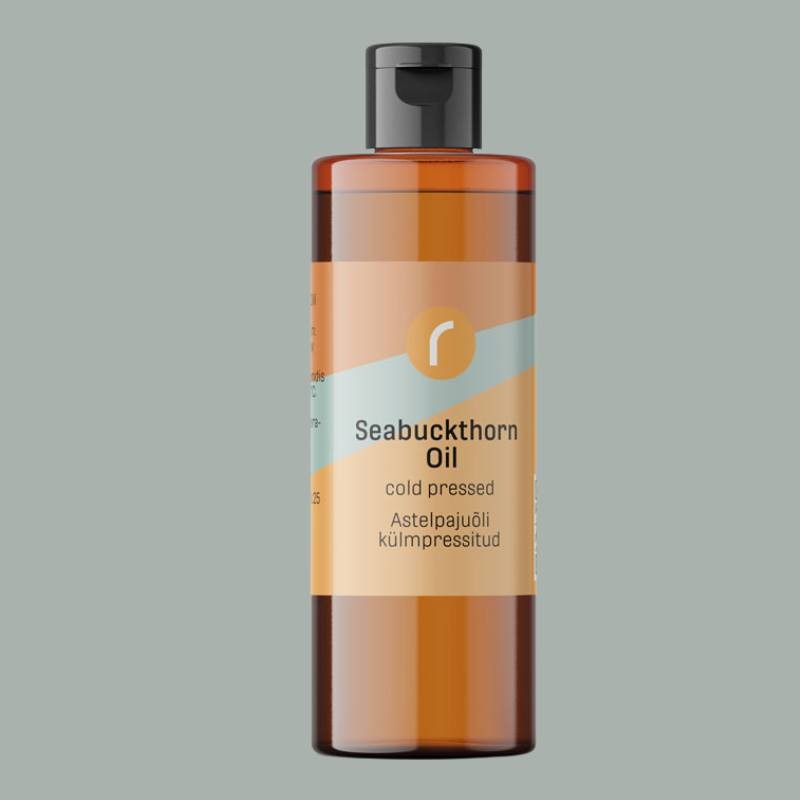
Seabuckthorn Oil 100 ml
search
  • Seabuckthorn Oil 100 ml

Seabuckthorn Oil

€12.00

Unit price: €12.00 / 100 ml

Includes VAT 24%
Option: 100 ml
Quantity

Best before: 27-01-2028

Until August 15, all regular‑priced products –15% for registered customers. Create an account here.

Must-have accessories

For 250 ml bottle

Pump for 100 ml bottle


Cold-pressed oil from vitamin-rich seabuckthorn berries is a rich source of carotenoids, phytosterols and tocopherols.

  • Helps to restore the moisture balance of dry and scaly skin.
  • Antioxidants in the oil help reduce signs of aging, such as wrinkles and fine lines, by protecting the skin from oxidative stress.
  • Helps to heal minor scratches and relieve inflammation.
  • Helps to improve the skin's protective barrier, which is why it is well-suited for products intended for irritated or sensitive skin.
  • The nutrients in the oil help improve skin elasticity, making it plumper.
  • The soothing effect on the skin helps to reduce redness and discomfort.
  • Orange-coloured oil gives the skin a brighter complexion.


Sea buckthorn oil – nourishing, carotenoid-rich active oil for dry, damaged, and ageing skin

Sea buckthorn oil is cold-pressed from the berries of Hippophae rhamnoides, sourced from Germany. It is one of the most nutrient-dense plant oils available, with an exceptional concentration of carotenoids, tocopherols, flavonoids, and phytosterols alongside a broad fatty acid profile. The oil has a deep orange colour and a characteristic scent – both a direct result of its carotenoid content, which is among the highest of any plant oil.

This is an active oil rather than a neutral base oil. It works best used in small amounts blended with other oils, where even a low percentage adds a meaningful nutritional boost to the formulation.

Sea Buckthorn Oil's main benefits

  • Exceptionally rich in carotenoids – including beta-carotene and lycopene, which give the oil its orange colour and antioxidant potency
  • Vitamins C and E – support skin repair, protect against oxidative stress, and strengthen the skin barrier
  • Anti-ageing – reduces the appearance of fine lines and wrinkles, improves skin elasticity
  • Soothing and healing – helps calm inflamed skin, supports recovery of minor damage
  • Barrier-strengthening – helps restore and maintain the skin's protective function
  • Skin toning – regular use gives skin a visibly healthier, more radiant appearance
  • Strongly pigmenting – will colour skin and finished products orange even at low usage rates

Sea Buckthorn fatty acid profile and active compounds

Sea buckthorn berry oil has a broad and distinctive fatty acid profile: linoleic acid (51%), oleic acid (29%), palmitic acid (7%), linolenic acid (7%), and stearic acid (4%). Sea buckthorn is also one of the very few plant sources of palmitoleic acid (Omega-7), which closely resembles the fatty acids found in human skin and contributes to the oil's skin-regenerating properties.

Linoleic acid (51%) is an Omega-6 fatty acid that strengthens the skin's lipid barrier, reduces water loss, calms reactive skin, and supports the healing of minor damage.

Oleic acid (29%) softens skin, supports cell renewal, and helps maintain moisture levels.

Palmitic acid (7%) forms a protective film on the skin and supports barrier function.

Linolenic acid (7%) is an Omega-3 fatty acid that soothes inflammation and helps reduce redness and irritation. Its presence alongside linoleic acid makes sea buckthorn oil particularly useful for reactive or compromised skin.

Stearic acid (4%) helps retain moisture in the skin and supports elasticity.

Carotenoids – sea buckthorn berry oil contains some of the highest carotenoid concentrations of any plant oil, including beta-carotene (which converts to vitamin A in the skin), lycopene, and zeaxanthin. These compounds are potent antioxidants that protect the skin from UV and environmental damage, support cell renewal, and give the oil its characteristic deep orange colour.

Vitamins C and E – vitamin C supports collagen synthesis and skin repair. Vitamin E acts as an antioxidant and helps extend the shelf life of both the oil and finished products.

Flavonoids and phytosterols protect the skin from environmental stress, reduce inflammation, and support the skin's natural renewal process.

Using sea buckthorn oil in cosmetics

Sea buckthorn oil suits dry, sensitive, mature, and damaged skin. Its strong colour and scent mean it is almost always used blended rather than alone. Even at 1–3% it adds a visible nutritional boost to a formulation. At higher percentages it will colour skin noticeably orange and leave a strong scent.

Recommended usage rates and applications:

Facial serums and anti-ageing oils – blend at 1–5% with neutral base oils such as sweet almond, jojoba, or rosehip. At 2–3% it adds antioxidant and anti-ageing benefit without strongly colouring the product. At 5% the product will have a visible orange tint.

Face creams and lotions – add to the oil phase at 1–3% for an antioxidant boost without significant colour impact. At higher percentages, the cream will turn noticeably orange.

Lip balms and lip glosses – use at 2–5%. The orange tint provides a subtle natural colour. Sea buckthorn is one of the main ingredients in the well-known three-ingredient lipstick formula developed by Lithuanian researchers.

After-sun and soothing products – the anti-inflammatory and barrier-supporting properties make sea buckthorn a valuable addition to after-sun and calming formulations. Use at 1–3%.

Intensive skin treatments and serums for very dry or damaged skin can be used at up to 10% in a targeted product, though the orange colour will be visible.

A note on colour

Sea buckthorn oil will colour the skin orange if used undiluted or at high concentrations. This is not harmful, but is something to plan for in formulation. At 1–3% in a finished product, the colour is minimal to moderate. At 5% and above, it becomes visible in the product and on the skin. The colour fades from the skin within a few hours.

Using sea buckthorn oil in soap

Sea buckthorn oil is not widely used in soap making. The active ingredients in the soap have no effect and the intense color tends to disappear during saponification.

Saponification values: NaOH – 0.133 / KOH – 0.186

Tech specs

INCI: Hippophae Rhamnoides Fruit Oil

Origin: Germany Processing:

Cold-pressed

Appearance: Deep orange liquid

Scent: Characteristic scent 

Store in a sealed container in a cool, dark place away from direct sunlight. The carotenoid content makes it sensitive to light and heat – keep sealed when not in use. Available in 100 ml and 250 ml bottles.

807338

Data sheet

Appearance
Colour: orange
Manufacturing Method
Cold pressed
Fatty Acids
Fatty acids are the main constituents of vegetable oils. Fatty acids determine the viscosity, absorption and other cosmetic properties of vegetable oils.In homemade soap made from fats and lye, the fatty acids affect the lather and hardness of the soap.
Oleic Acid
29%
Oleic acid softens the skin and helps the skin renew itself. Suitable for chapped or sunburned skin. The oleic acid in the soap is low-foaming, but softens the skin.
Linoleic acid
51%
Linoleic acid softens the skin and helps reduce flaking. In cold process soap acts as a skin softener.
Stearic acid
4%
Stearic acid helps maintain moisture in the skin, increases skin elasticity and helps skin recover faster from injuries. Stearic acid gives soap hardness and dense foam.
Palmitoleic acid
5%
Palmitoleic acid is a monounsaturated omega-7 fatty acid that improves skin hydration by reducing moisture loss. It has anti-inflammatory properties and is suitable for use in products that aim to reduce skin inflammation and redness. In addition, palmitoleic acid has antibacterial properties, making it a good additive for products that aim to reduce bacterial growth on the skin.
Linolenic acid
4%
Linolenic acid soothes inflamed skin. It helps relieve itching, redness and irritation.
Palmitic Acid
7%
In cosmetic products, palmitic acid forms a protective layer on the surface of the skin. In soap, palmitic acid gives the soap hardness and a thick, creamy lather.
INCI
Hippophae Rhamnoides Fruit Oil
Source
Natural ingredient
Country of Origin
Germany
Tooterühm
Taimne õli
Comments (0)
No customer reviews for the moment.

Data sheet

INCI
Hippophae Rhamnoides Fruit Oil
Source
Natural ingredient
Country of Origin
Germany
Tooterühm
Taimne õli
Appearance and scent
Appearance
Colour: orange
Fatty Acid Profile
Fatty Acids
Fatty acids are the main constituents of vegetable oils. Fatty acids determine the viscosity, absorption and other cosmetic properties of vegetable oils.In homemade soap made from fats and lye, the fatty acids affect the lather and hardness of the soap.
Oleic Acid
Oleic acid softens the skin and helps the skin renew itself. Suitable for chapped or sunburned skin. The oleic acid in the soap is low-foaming, but softens the skin.
29%
Linoleic acid
Linoleic acid softens the skin and helps reduce flaking. In cold process soap acts as a skin softener.
51%
Stearic acid
Stearic acid helps maintain moisture in the skin, increases skin elasticity and helps skin recover faster from injuries. Stearic acid gives soap hardness and dense foam.
4%
Palmitoleic acid
Palmitoleic acid is a monounsaturated omega-7 fatty acid that improves skin hydration by reducing moisture loss. It has anti-inflammatory properties and is suitable for use in products that aim to reduce skin inflammation and redness. In addition, palmitoleic acid has antibacterial properties, making it a good additive for products that aim to reduce bacterial growth on the skin.
5%
Linolenic acid
Linolenic acid soothes inflamed skin. It helps relieve itching, redness and irritation.
4%
Palmitic Acid
In cosmetic products, palmitic acid forms a protective layer on the surface of the skin. In soap, palmitic acid gives the soap hardness and a thick, creamy lather.
7%
Manufacturing Method
Cold pressed
Cookie consent